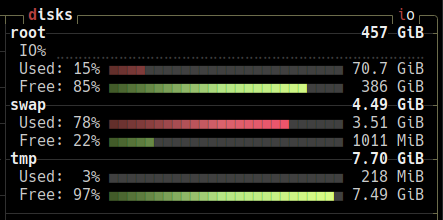
i have only one internal ssd and no external drives are connected
From Wikipedia, the free encyclopedia
Linux is a family of open source Unix-like operating systems based on the Linux kernel, an operating system kernel first released on September 17, 1991 by Linus Torvalds. Linux is typically packaged in a Linux distribution (or distro for short).
Distributions include the Linux kernel and supporting system software and libraries, many of which are provided by the GNU Project. Many Linux distributions use the word "Linux" in their name, but the Free Software Foundation uses the name GNU/Linux to emphasize the importance of GNU software, causing some controversy.
Community icon by Alpár-Etele Méder, licensed under CC BY 3.0
i have only one internal ssd and no external drives are connected
so it's kind of like the opposite of a swap file
If I wanted to use some analogies, I would imagine RAM is the space on your desk and disk is the drawers behind you.
Everytime the computer shutdown, the desk is totally cleared.
When you work, you have stuff on your desk space, files that you need temporarly are also on your desk because you want to keep them and clear them on shutdown, this is what
/tmpis for.Swap is when you desk is starting to be full, but you still need the data to work, so you have a special part in the drawer behind you that you move stuff that you don't need right away but want to make some space on your desk. It is slightly slower to access since you need to move from your chair to get it.
It is not uncommon for Linux to eagerly move things in swap when you are not actively using them in RAM. This allows the system to be ready if you need more space. Linux is mart enough to handle moving all of this around (RAM, swap, tmp) as efficiently as possible so that it doesn't impact your usage of the computer. Usually tuning these things is only necessary if you have some very specific issues with your system.
Also, since your disk is an SSD, you probably will not see a very big impact on performance. Swapping was really an issue in the past with spinning disks. SSD is not as fast as RAM, but magnitude faster and snappier than spinning disk.