The fact that this isn't considered outright fraud is disturbing. This person OWNS the device, yes? They're not leasing it.
FFS, this should be illegal.
This is a most excellent place for technology news and articles.
The fact that this isn't considered outright fraud is disturbing. This person OWNS the device, yes? They're not leasing it.
FFS, this should be illegal.
I agree with you that this should be illegal. I expect this was in the terms of service, though. Since we have no laws restricting this kind of bullshit, the company can argue that they're within their rights.
We need some real legislation around privacy. It's never going to happen, but it needs to. We need a right to anonymity but that is too scary for advertisers and our police state.
Terms of service need to stop being treated like law.
They're not law as long as you can afford the lawyers and legal costs to fight them. Which is, of course, the problem and the system working as designed.

Just because something's written in the terms of service, doesn't mean it's legal.
I expect this was in the terms of service, though
While I expect the same, there's also just a reasonablility standard. If Meta and Google updated their TOS to say that users agreed to become human chattle slaves to mine cobalt and forfeit their rights, no court (...right, SCOTUS?...right?) would uphold that. A TOS is a contract, but it's mostly for the protection of companies from liability. Takign active steps to brick someone's device over the device not connecting to it's C2 server (the company had zero evidence this was done intentionally and a router firewall misconfiguration could just have easily done the same thing), is IMO something that should result in a lawsuit.
There needs to be a huge neon orange warning on the Front of these products that explains, clearly, that you don't own it, your privacy will be invaded and the company can disable it at anytime. This will stop people from buying this garbage, and hopefully companies will stop if they want our money.
My life rule is, if it says Smart on it, it's never going to be smart. It will always cause trouble.
IMO "Smart" refers to the lawyers that got paid to write a 900-page TOS that lets a company do whatever they want.
My robot vac will only operate when connected to the Internet so it's only allowed to communicate when actually in use. As soon as it returns to the charger Internet access is automatically blocked.
Unfortunately the manufacturer has deliberately made this as inconvenient as possible. If communication is blocked for more than a few hours the vacuum loses all maps and will no longer even load saved maps from the Tuya app. To use it the vac must be powered down and the app killed. Only then can a saved map be restored.
It's too bad it's so useful.
it’s only allowed to communicate when actually in use.
What's the point? The manufacturer is interested in the map of your apartment and usage statistics. What do you think it's sending when not in use? Does it have a microphone or something?
Since I haven't pulled it apart or tried to decrypt the ssl traffic I have no idea whether it has "a microphone or something." That's the point.
Keeping it offline some of the time isn't effective against passive data collection unless you're willing to take the inconvenient step of factory-resetting it each time you're about to use it. Anything it collects it can just hold onto until it next gets the chance to upload.
SmartTVs will hold onto your data as long as they have storage, even through a factory reset. So if you sell it and the next person hooks it up to the Internet then the data is uploaded.
I know it can be done, so it wouldn't shock me at all to find out that it does happen, but do you know of any manufacturers who have been proven to do this?
My robot vac will only operate when connected to the Internet
That would trigger me to return it to the store. "It doesn't work"
Stalkerware is criminal digital slavery. It is sale and ownership of a part of a person to manipulate and exploit them.
I think your comparison to slavery is a bit overblown and minimizes the tragedy of actual slavery. But I agree with the sentiment.
There's something not working in this article.
They say it "makes sense" for the device to basically send the plan of your home to some online server, because the vacuum is not powerful enough to process this data on its own. This is already a bit horrifying to me, but okay.
And then when that guy blocked it out, the vacuum "worked for a while" before something sent the kill command through an update.
How come is it still working at all if navigation requires that server?
It's not the navigation that requires the server but the processing of the mapping data.
Which in itself is BS because most of these vacuums come with hardware roughly equivalent of a top of the line smartphone from about 5-6 years ago. They can easily do the raw data to map conversion, even if it's a bit slow and takes 20-30 seconds.
Also if you read the article it specifies that the damn thing is already running Google Cartographer which is a SLAM 3D map builder software - one of the better pro-grade mapping software suites, mind you. So the whole claim of cloud needed for processing is BS.
My VR headset can create pretty accurate 3D maps of my environment like nothing, and it only uses cameras to do so, so I can imagine it's doable.
Then, yeah, it doesn't "make sense" for that thing to externalize that.
If I don't own it 100% then reimburse me if you disable it.
For me the worst part is that someone developed the functionality to monitor and track, until the signal is lost, and if so, kill. It's really crazy how daring this is.
As useful a smart device are, it's very annoying that the company behind it are always either: 1) a scumbag that will collect data and will lockdown the device if people doesn't use it their way; 2)incompetent idiots that can't make a good software to save their life. So by using these device you basically have to pick the thing that you're willing to lose.
It's really too bad because robovac save me a lot of time and mental exhaustion.
I have just purchased a Dreame L10s Ultra and have had the PCB for a breakout board made and components for setting it up ordered. In a few days I should get the last bits and I will be able to root the device and have it connect to Valetudo managed through Home Assistant. Fully local operation with basically the same features but none of the privacy issues. As soon as I can get it connected I will be able to use it just like a robot I actually own should without some random third party being involved in every single operation.
I specifically got one which can run valetudo and it works great for over two years now. Without sending images of my flat to china or the us
I am planning to make a list of devices I really do NOT want near me. Starting with this one.
Having not read the article: “Let’s apply Hanlon’s Razor: Oh, probably it just collects the data locally and caches it until the vendor’s servers are reachable. After a while the data partition was full and it stopped working as this case was never deemed possible when this was developed.”
Having read that the kill command was logged and he found it in the logs: “ok, there are no technical details, so there might still be a misunderstanding, but that’s not what I expected!”
I was thinking about getting one but I learned that they do require a lot of maintenance like cleaning the brushes and you have to change parts regularly. That sounds like more work they just sweeping from time to time. Also, broom has a lower carbon footprint.
Ours has needed very little maintenance and has quickly become a necessity because it gets the floors much cleaner that we ever did. An unexpected consequence is that the whole house stays cleaner because we still spend some of the time and energy we were spending on sweeping on other cleaning tasks.
As much as the thing irritates me you'd have to pry it from my cold, dead hands.
Had a kill command actually been sent, or does the device just not work without a remote server talking to it every so often?
Because the second one is probably worse from a "what if this company goes bust" standpoint.
Don't worry, the quality of the modern hardware is so shitty, it will not outlive the company for long
Man itd be great if there was an answer to this. Maybe in an article somewhere. Guess we'll never know.
Not to fear! Here is the relevant part so the next person coming by doesn't have to read the article:
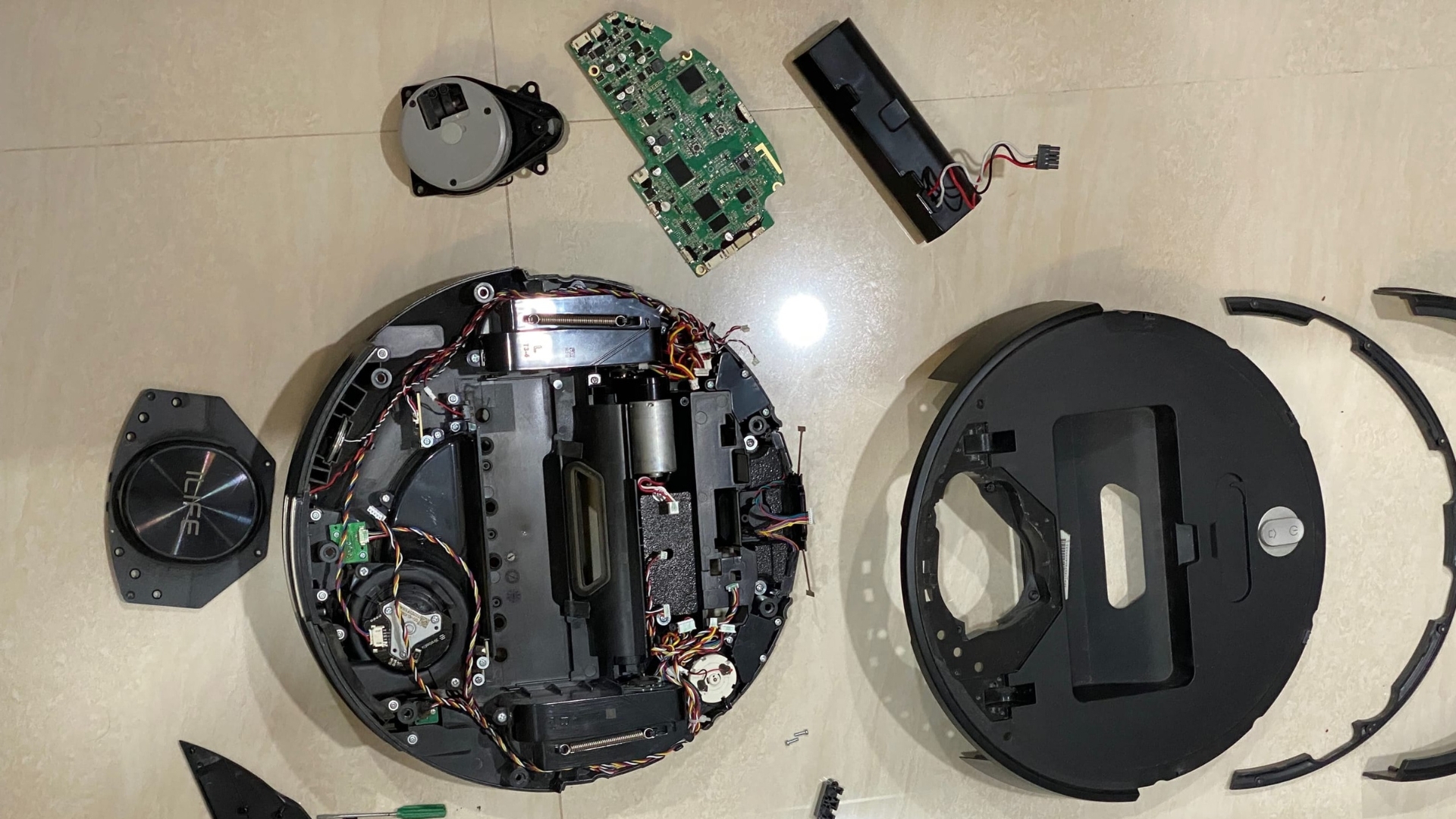
deep in the logs of his non-functioning smart vacuum, he found a command with a timestamp that matched exactly the time the gadget stopped working. This was clearly a kill command, and after he reversed it and rebooted the appliance, it roared back to life.
(Image credit: Harishankar)
So, why did the A11 work at the service center but refuse to run in his home? The technicians would reset the firmware on the smart vacuum, thus removing the kill code, and then connect it to an open network, making it run normally. But once it connected again to the network that had its telemetry servers blocked, it was bricked remotely because it couldn’t communicate with the manufacturer’s servers. Since he blocked the appliance’s data collection capabilities, its maker decided to just kill it altogether. "Someone—or something—had remotely issued a kill command,” says Harishankar. “Whether it was intentional punishment or automated enforcement of 'compliance,' the result was the same: a consumer device had turned on its owner.”
I wish companies would at least offer a "no data collecting/selling" price option. Like, how much would they make from selling my data? Just give me the option to pay that extra amount so I can buy a vacuum without thinking about how it's spying on me.
My concern is that they'll include the equipment for spying on you, and just enable it later.
I bought a Hue because it said "no online account required!" Later they changed their mind.
I want the promise plus open standards and a base of libre software. I want them to tie themselves to the mast.
Same story with this guy (in french)
https://www.youtube.com/watch?v=OGMRUiBOFj0
Highly recommend watching his stuff, might be very technical but also super methodical
...when i 'buy' something, should i not own and be able to use it and all functions until the end of it's mechanical processes?..