RustDesk is excellent, it's basically open source TeamViewer. And if you don't want to use their servers, you can even host your own.
this post was submitted on 12 Feb 2026
50 points (98.1% liked)
Linux
63770 readers
687 users here now
From Wikipedia, the free encyclopedia
Linux is a family of open source Unix-like operating systems based on the Linux kernel, an operating system kernel first released on September 17, 1991 by Linus Torvalds. Linux is typically packaged in a Linux distribution (or distro for short).
Distributions include the Linux kernel and supporting system software and libraries, many of which are provided by the GNU Project. Many Linux distributions use the word "Linux" in their name, but the Free Software Foundation uses the name GNU/Linux to emphasize the importance of GNU software, causing some controversy.
Rules
- Posts must be relevant to operating systems running the Linux kernel. GNU/Linux or otherwise.
- No misinformation
- No NSFW content
- No hate speech, bigotry, etc
Related Communities
Community icon by Alpár-Etele Méder, licensed under CC BY 3.0
founded 6 years ago
MODERATORS
Thank you very much, that GUI looks very similar to Teamviewer which they already know.
if you don't want to use their servers, you can even host your own
I didn't download and try it yet. Do you know if you can indeed use their servers as well without self-hosting? I went to their website and scrolled through the GitHub FAQ and at first sight I can only see the self-hosted option. They even advertise it as 'non SaaS'.
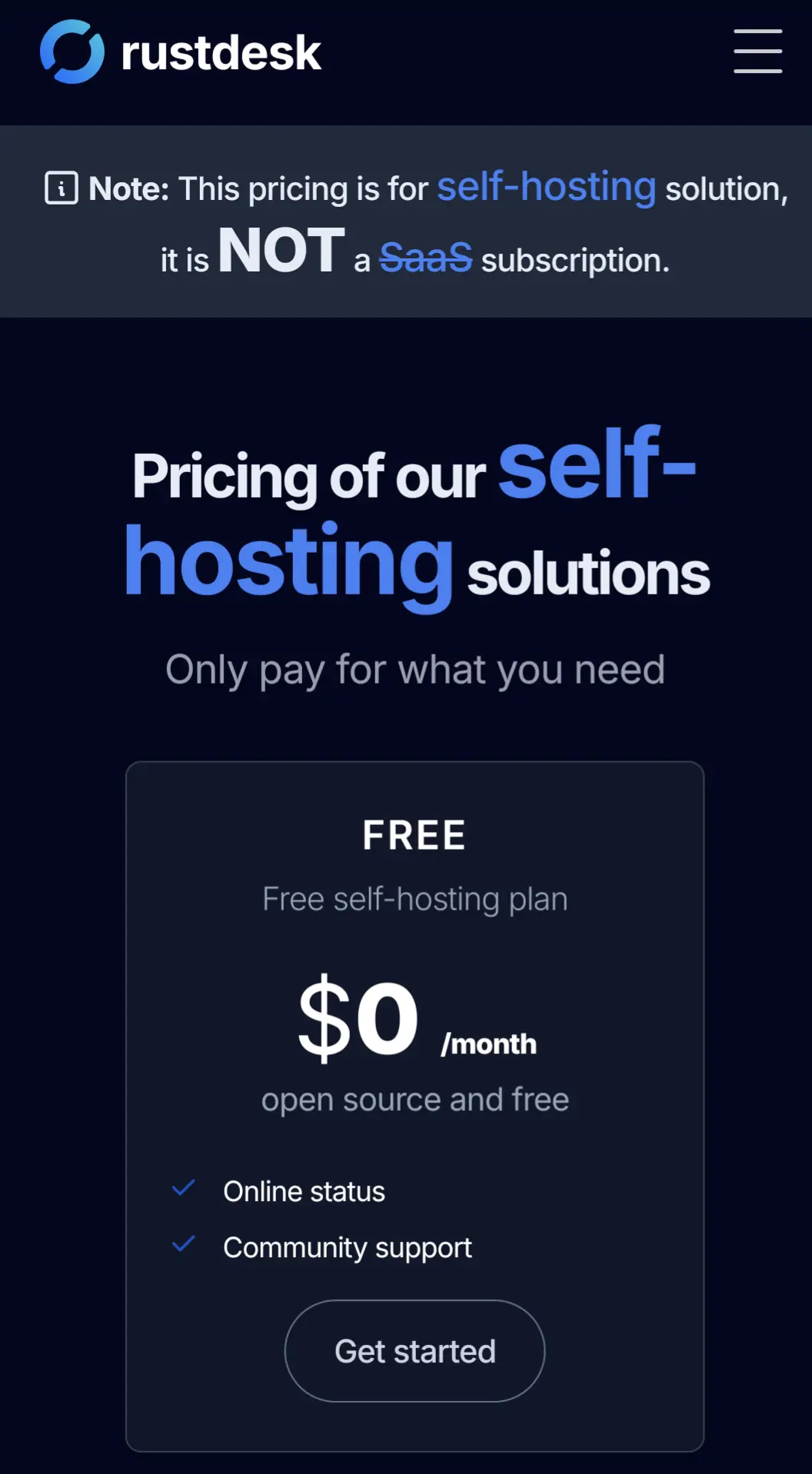
Yes, you can just install and use it straight away, no need to mess with self-hosting if you don't want to. You also don't need a subscription, that just unlocks some extra features.
Once you install the client, it will connect to the public server and give you a message of "For faster connections use your own server" or similar, but thats it. You can test that with your own machine (or android/ios if you don't have a second pc)
Did they clear up those China allegations?
Do they need to provide a back door?
I'm using Tailscale plus the built-in RDP in GNOME with the Remmina client.
supporting 400+ laptops from previously tech-illiterate users in the field. we tried everything for remote patching and fixing things and nothing worked universally. that includes stuff shipped with them (ssh, Gnome and Plasma RDP, VNC, etc) and 3rd party FOSS things. wireguard-ing all them laptops for remote access introduces buncha complications at this scale.
only thing that works: bring it to the "shop", ansible script to exfil home subvolume, install fresh ubuntu (working on replacing that with debian), patch snap and bunch of other annoyances, restore /home.
seeing as how you only got grams and co. to take care of, wireguard + ssh is the only low-overhead, works-most-of-the-time solution.
Did you try meshcentral? It's a selfhosted MDM.
just gave it a cursory look, will look further, thank you. couldn't find the details on client load/traffic; we can't burden these people with excessive network traffic just because it might be needed one day.
Not FOSS, but AnyDesk is pretty nice, easy to use, and works on almost all platforms. For unsupervised access you have to change some settings in person, but otherwise it's as simple as "start the red program, tell me the (persistent) number, and click the green accept button"
i would do vnc through tailscale or reverse ssh
Get an SSH tunnel working first.
That'll find all the problems poking holes through home routers, dynamic public IPs, etc.
Once you've got that part running, then you can look at VNC or... and hear me out... I just run the X11 apps remotely. So I'm opening their apps on my laptop, changing the config for their session and it's done.
I reconfigured Thunderbird that way when we moved email providers foe the family's email.
No need for VNC to transmit all their screen when just the app is needed 😉
I like the idea. But vnc helps with troubleshooting because you can see their screen and walk them through steps so they won’t have to call you again. Thats much harder without visuals because quickly everything becomes "this thing over there", frequently changing frame of reference.
Yep, totally agree... the right tool for the right job.
I have SSH with key based auth for connecting to my grandma over Tailscale. If I need remote desktop, I do VNC over another SSH-tunnel.
DWS service works for me, but if you use them, make sure you donate them a nice chunk of money ... they're a community supported service.
I personally think anydesk is the easiest to deploy and use, cross platform and little effort.
Rustdesk is great too and my go to as a self hosted option.
Use windows 10 21h2 iot ltsc. Security updates till 2032.
It will buy you some time to see how things shake out with windows.
That sounds like an interesting fallback and better than Windows 11. Do you need a new licence for that or can you just change from Windows 10 Pro to IOT LTSC?
Someone already said massgrave, and they’re right, but I wanna be 100% clear: Microsoft can’t take these away. If they did then smart fridges would be complaining about how they’re not registered, massive enterprises would have to completely change how they provision systems, pc manufacturers would have to change their processes and even if it was as simple as a change to the generic disk image they ship (it’s not) they’d have to handle all the systems out there in the world.
And
Even if Microsoft went ahead anyway and removed the ability to use some method (like they did with kms38, which had nothing to do with mas and everything to do with addressing the end of the Unix epoch) there are methods they cant effectively remove like hwid.
Anyway, go to the massgrave page about 21h2 iot ltsc and read up.
All that would happen absolute worst case scenario if MS breaks this is your users would get a whining complaint about not being activated. Get a small "Activate Windows" logo stuck in the lower right hand of their screen and would lose the ability to change wallpapers, customize windows colors, etc.
To be clear it wouldn't break the install and it would leave it in a state in which you could use an updated version of MAS (reminder MAS supports multiple activation options) to fix it remotely.
massgrave.dev
Thanks, but this seems to be rather an unofficial hack, no? If Microsoft decides to block this approach, the setup may cause trouble out of a sudden which I'd like to avoid as my relatives live quite far away.
well yeah, it surely is. win10 iot ltsc itself is defo getting support till 2032, but massgrave's hwid/tsforge may get blocked at some point, though most people highly doubt that since m$ doesn't really care at this point. (heck, the massgrave repos are hosted on m$ owned github) in addition to that, massgrave's hwid mode generates an hwid on microsoft's servers just like genuine windows licenses, so i'm pretty sure it'll remain working, even if the method to generate hwid gets blocked somehow..
i do believe switching to a gnu/linux distro is a much better choice, but this is also an option if your relatives really prefer using windows or need to.
Not Teamviewer-ish but on Windows I've set up a simple batch file that launches a reverse VNC connection (using TightVNC) from the remote system to myself in the case someone needs me to look at something on their desktop. Nothing fancy about it, just something simple to get going if you don't want or need anything more complex.
Haven't done it on Linux yet but I suspect a bash script + a VNC app (TigerVNC maybe?) would be able to do the same thing.
Please, don't expose VNC to the internet, ever. It's a horrendously insecure protocol that uses plaintext passwords of no more than 8 characters and everything that passes over the connection is unencrypted and visible to anyone sniffing the traffic.
Once it was the only option, but there are dozens of better things out there now which should be used, even on a lan or vpn.
I love Linux, and use it on all machines and devices possible, but I would never push my non tech savvy family to use it. My wife has a non windows 11 compatible with an i5 7200u CPU. I installed windows 11 on it very easily. She is happy, and the laptop works perfectly.
I would first ask your relatives if they really want Linux or if they would prefer windows 11.
If they want Linux, mint is probably the best non tech savvy option. Then use tightvnc or similar with an ssh tunnel, tailscale or something similar. Create a desktop shortcut that launches and creates the connection.
Thanks for your post.
IMHO Windows is getting harder to use with every update. Context and start menus are changing, you get annoyed by One Drive, asked to use a Microsoft account for everything, suddenly stuff like Notepad has Copilot integration, suddenly links open in Edge instead of your default browser and you're confused that your bookmarks are gone etc. Apart from that, hacks to install Windows 11 on non-supported hardware might work fine today, but may break with every next update.
I moved my mum to Linux Mint one year ago and so far didn't have issues or complaints. In fact she's super happy with the Solitaire game as it does have way more play modes while not having any annoying advertisements. She's using Firefox and LibreOffice which she already had on Windows before. It was less of a deal for her than a new Android major release on her phone.
But my mom is living much closer to me. In worst case I can fix any issue in person. Unlike these other relatives. There I need some kind of support access for troubleshooting.
My non techsavy mother has been using Linux mint for about 4 months now without problems after decades of windows. She’s been retired for years.
Just saying, it’s possible. It’s even quite painless.
While it is good to have empathy and understanding for less technical folks, OP may be in a better position to know what is realistic for their family and level of support they can provide
My wife and windows could not get along, to many inconsistencies. I set up a repeatable comfig NixOS for her with GNOME. She now never complains about the computer, since it is always the same.