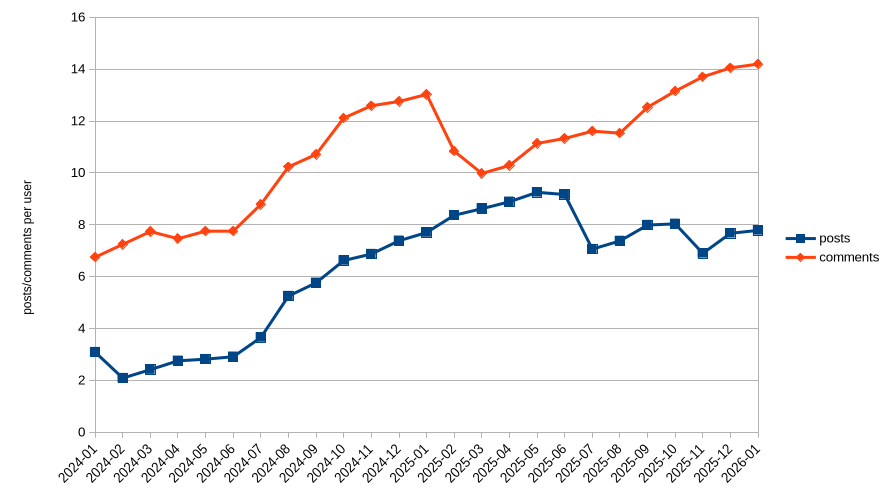
Following https://tarte.nuage-libre.fr/c/fediverse/p/194717/we-need-more-users I decided to explore data a little bit more. I'm not the biggest fan of growth-as-as-target so I wanted to see how much the people were participating in the discussion.
The data
I took the data from the API explorer in https://api.fediverse.observer/ with this query:
query {
  monthlystats {
    date_checked
    softwarename
    total_posts
    total_users
    total_comments
  }
}
Then parsed the json with this https://jqlang.org/ filter:
jq '.data.monthlystats | map(select(.total_users > 0 and (.softwarename == "lemmy" or .softwarename == "mbin" or .softwarename == "kbin" or .softwarename == "piefed"))) | group_by(.date_checked) | map( {date_checked: .[0].date_checked, total_users: ([.[] | .total_users] | add), total_posts: ([.[] | .total_posts] | add), total_comments: ([.[] | .total_comments] | add)}) | map({date_checked, posts: .total_posts/.total_users, comments: .total_comments/.total_users}) | sort_by(.date_checked) | map([.date_checked, (.posts | tostring), (.comments | tostring)]) | .[] | @csv'
(As you see I filtered for the threadiverse. I also did the same with all software, I'll put the graph for that in comments)
Then did a good old' chart
What to think of it
I don't know. Users' activity is on the rise and I find it nice
That's a very important question we need to address !
It makes sense for platforms to block reuse of identifiers: they identify something, if the thing changes it should get a new identity.
Identities are fundamentally that: how to recognize that something is not something else. Note that it really is something: the same person can have multiple identities, and an identity can be shared by multiple persons.
The main issue is that we have been immersed inside a State-based system for so long we forget it exists. The first thing that comes to mind when we talk about identities is our state-delivered identity: name, surname, address, driving license number, etc... there's a central all-powerful authority deciding what identity is given to whom, and they are unique and active as long as the State decides. In practice this has made identities a public-facing concern because the State is in charge of everything.
Centralized platforms, of course, reproduce the model. Both the State and capitalist platforms (or capitalist anything) act under the paradigm of total domination, there's no surprise here: the platform owns your identity, your data, your you. When we reproduce the same thinking in open/decentralized platforms we inherit the mentality although everything points to not actually wanting it: we don't want a platform to have control over our identity/identities unless we have control over the platform, yet in practice we do. We link an identity with a name, so of course names must be unique
We need to go back to the roots: what is an identity ? A way to differentiate two things to someone. Who can guarantee the identities we have ? Our connections. "Mom" is an identity in my contacts app; this identity is obvously not the same identity as "Mom" in your contacts app, although the name is the same. That's because this identity is not the same to me that it is to you. The entity "using" the identity is fundamental. That's something we forget when using centralized platforms: the entity "using" my identity isn't my contacts, it's the platform. To the platform, everyone must be unique, so must have a different name in their "contacts app". That is not a model that cares about us but about itself.
What model cares about us ? A model that puts the focus back not on the individuals being represented, but on the relationship. An identity can never be defined by biometrics or hardware keys or whatever technic that technosolutionnist rave about. Technosolutionnists by definition do not care about sociology, so they shouldn't be listened to for sociology issues. An identity will always be defined by who recognizes you as such.
What does it mean in practice ? Basically, we need to build communities of people taking care of each other. My access to the group chat shouldn't be defined by a technical solution to access the app; if I lose access to the technical solution, the community still knows my identity as the same, so it must be able to re-integrate me without a hurdle, whatever the technical means.
What this means is that identities shouldn't be public-facing. They should be something inside a community only, defined by it with the means it decides.